


This tutorial shows how to Convert date to Julian format in Excel using example below.
Convert dates stored as text to normal Excel date with formula. Here I will talk about using DateValue function to change the text dates to proper Excel dates. When you input '2013/03/21 into a cell, that apostrophe before the date is used to indicate to Excel that the value in the cell is text value (see following screenshot). You can convert. Because Error Checking in Excel can identify text-formatted dates with two-digit years, you can use the automatic correction options to convert them to date-formatted dates. You can use the DATEVALUE function to convert most other types of text dates to dates. Convert text dates with two-digit years by using Error Checking. There are four simple ways to convert date to text in Excel: Using the Text Function (most commonly used) Using the Text to Column option; Using the Copy-Paste method; Using VBA; Use of Date to Text in Worksheet. Excel Text function is commonly used to convert a numeric value to a text string and display it in the format you specify so we can.
If you need to convert a date to a Julian date format in Excel, you can do so by building a formula that uses the TEXT, YEAR, and DATE functions.
Formula
Explanation
Background

“Julian date format” refers to a format where the year value of a date is combined with the “ordinal day for that year” (i.e. 14th day, 100th day, etc.) to form a date stamp.
There are several variations. A date in this format may include a 4-digit year (yyyy) or a two-digit year (yy) and the day number may or may not be padded with zeros to always use 3 digits. For example, for the date January 21, 2017, you might see:
Solution
For a two-digit year + a day number without padding use:
For a two-digit year + a day number padded with zeros to 3 places:
For a four-digit year + a day number padded with zeros to 3 places:
How this formula works
This formula builds the final result in 2 parts, joined by concatenation with the ampersand (&) operator.
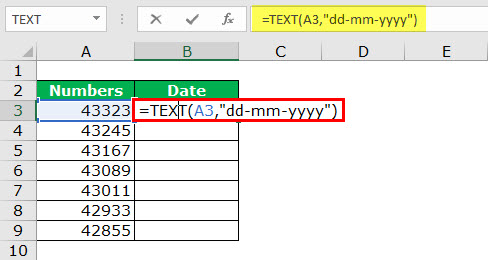
On the left of the ampersand, we generate the year value. To extract a 2-digit year, we can use the TEXT function, which can apply a number format inside a formula:
To extract a full year, use the YEAR function:
On the right side of the ampersand we need to figure out the day of year. We do this by subtracting the last day of the previous year from the date we are working with. Because dates are just serial numbers, this will give us the “nth” day of year.
To get the last day of year of the previous year, we use the DATE function. When you give DATE a year and month value, and a zero for day, you get the last day of the previous month. So:
gives us the last day of the previous year, which is December 31, 2015 in the example.
Now we need to pad the day value with zeros. Again, we can use the TEXT function:
Reverse Julian date
Convert Date In Excel To Month
If you need to convert a Julian date back to a regular date, you can use a formula that parses Julian date and runs it through the date function with a month of 1 and day equal to the “nth” day. For example, this would create a date from a yyyyddd Julian date like 1999143.
If you just have a day number (e.g. 100, 153, etc.), you can hard-code the year and insert the day this:
Convert Date In Excel To Yyyymmdd
Where A1 contains the day number. This works because the DATE function knows how to adjust for values that are out of range.